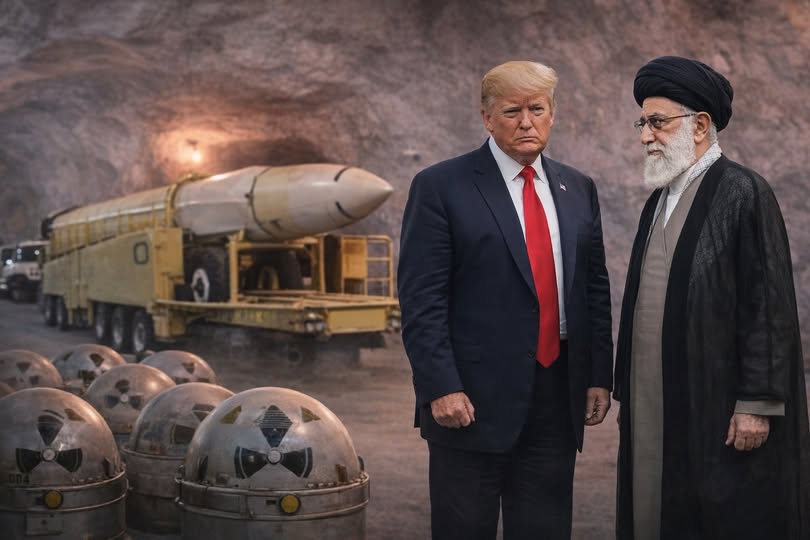

Hidden deep beneath layers of rock and reinforced concrete, these underground installations—often described as “missile cities”—have drawn global attention not just for their scale, but for what they represent.
They are not simply storage sites.
They are a strategy.
Depth as Deterrence
Reports suggest some of these facilities extend hundreds of meters underground, designed to endure sustained aerial strikes and remain operational under pressure. For Iran, this approach reflects a clear objective: ensure that its capabilities cannot be easily neutralized in the opening stages of a conflict.
That kind of resilience changes calculations.
When assets are difficult to reach, the cost of escalation rises—not only materially, but politically.
A Broad and Evolving Arsenal
According to assessments often cited by United States Central Command, the missile inventory attributed to Iran is both large and varied. Systems like the Shahab-3, Sejjil, and Khorramshahr extend reach across much of the region.
Range matters, but so does adaptability.
Solid-fuel systems, improved guidance, and mobile launch capabilities all point to a program that has moved beyond basic deterrence into something more flexible and responsive.
Still, capability does not equal inevitability. It reflects preparation, not necessarily intent.
New Frontiers: Speed and Evasion
Recent attention has focused on newer projects such as the Fattah-2. If even part of the claimed maneuverability and speed proves accurate, it would challenge existing defense systems like the Patriot missile system and Iron Dome.
At the same time, cruise missile platforms like the Soumar emphasize a different approach—low-altitude flight, reduced visibility, and delayed detection.
These developments show a shift: not just building more, but building differently.
The Role of Drones
Alongside missiles, systems like the Shahed-136 have introduced a new layer to modern conflict.
They are relatively simple, comparatively inexpensive, and effective when used in large numbers.
Their purpose is not always precision.
Sometimes it is pressure—forcing defenses to respond repeatedly, until resources thin and gaps appear.
A Measured Perspective
It is easy to view these developments only through the lens of threat.
And there is real concern.
But there is also a broader reality: much of this buildup exists as part of deterrence dynamics that shape the region. Each side develops capabilities not only to act, but to prevent action from others.
This does not remove the risk.
But it places it within a framework where escalation is often avoided precisely because the cost is understood.
What Remains Uncertain
Predictions about longer-range capabilities continue, with some analysts suggesting that intercontinental reach may still be years away.
Until then, the immediate implications remain regional—serious, but contained within a balance that has not yet fully broken.
The deeper truth is that strength alone does not decide outcomes.
How that strength is held, signaled, and restrained matters just as much.
Final Thought
These underground systems are built to endure.
But endurance is not only physical.
In a landscape shaped by tension and capability, stability depends on something less visible—the willingness to act with restraint when action is possible.
That is the line that matters most.
And it is still being held.