
How much of a person’s life can be built on a lie before the whole structure just tilts over? I ask myself that every time I walk past the hall mirror. For nine years, I lived in a house that felt like a museum. It was clean, it was quiet, and it was entirely, suffocatingly empty. I spent every Tuesday evening at the Route 4 Women’s Crisis Center, scrubbing counters and folding donated clothes, believing that if I did enough good work, the universe would eventually forgive me for the one thing I couldn’t fix.
I was Arthur Leigh Rowan, the dignified widow of the late Thomas Rowan, a man who built half the office parks in this county and whose portrait sat on my mantel like a saint’s icon. I told myself I was a good person. I told myself I was a woman of standards.
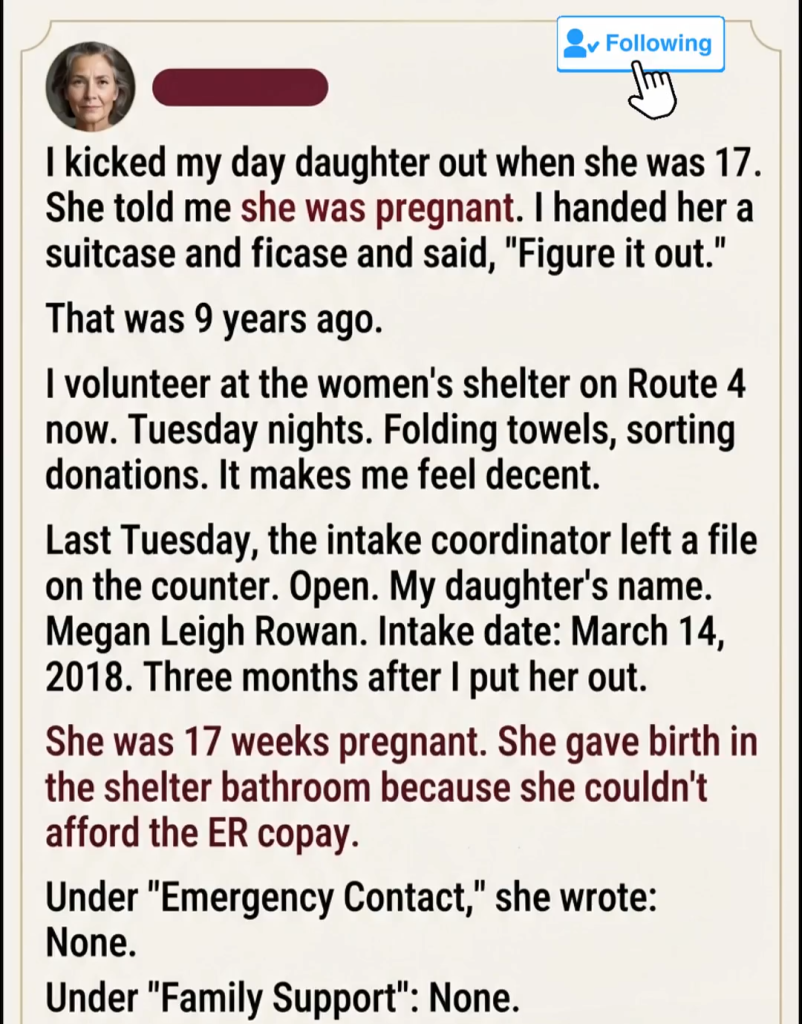
Last Tuesday, the shelter was quiet. It was 8:42 PM, and the heavy, humid air in the back office felt like it was pressing down on my lungs. The coordinator, a kind woman named Brenda, had been pulled away to the loading dock for an emergency intake, leaving the intake desk a mess of papers. I was just passing by with a stack of fresh white towels when I saw it. A thick, worn Manila folder had been left open on the edge of the desk. The label on the tab, written in that familiar, slanted script I hadn’t seen in nearly a decade, stopped my heart cold. Rowan, Megan Leigh. Intake Date: March 14, 2018.
I stood there for a long time. The fluorescent lights hummed in a way that made my head throb. I shouldn’t have touched it. I knew that. But my hands moved on their own, flipping open the folder before I could talk myself out of it. There she was. A photograph clipped to the top of the file showed my Megan at seventeen, her face gaunt, her eyes looking straight into the camera lens with a terrifying, hollow sort of exhaustion. She was pregnant. She was alone. She was at a place for broken women, and I hadn’t even known she was still in the state.
My mind raced back to that morning in 2015. It was a Tuesday, just like this. Megan had sat at our kitchen table, her hands trembling as she pushed a piece of toast around her plate.
She had tried to tell me. She had started a sentence, her voice small and brittle, but I had cut her off. I didn’t want to hear it. I didn’t want the shame in my house. I didn’t want the neighbors whispering about my daughter. I had packed her blue hard-shell suitcase, shoved it onto the porch, and told her that if she wanted to live like a child, she could figure out how to be an adult somewhere else. I gave her fifty dollars and watched her walk down the driveway without looking back. I had been so proud of my resolve. I thought I was teaching her a lesson.
I sat down on the cold linoleum floor of the office, pulling the folder into my lap. I started reading the notes, my hands shaking so hard the pages rattled. She had arrived at this shelter three months after I cast her out.
She was seventeen weeks pregnant. She had been living in a car, then a park, then a basement. The entry under Emergency Contact was just a thick, black marker line drawn through the box. Under Family Support, she had written one word: None. I kept reading, my breath coming in short, ragged gasps. I finally found the page she had written herself, the mandatory reason for seeking shelter.
Her handwriting was light, like she was afraid to press too hard on the paper. She wrote: “My mother found out I was pregnant and told me to figure it out. I tried to tell her that the father was her…” The sentence trailed off at the bottom of the page, where the paper was jagged and torn. I flipped the page, my heart pounding against my ribs like a trapped bird. Attached to the back was a pink police liaison referral form from 2018. It was a formal record of a complaint. The subject of the report was Thomas Rowan.
The room tilted. I felt sick, a deep, rising nausea that made the walls seem to spin. Thomas. My husband. The man I had spent five years mourning. The man I had defended against every rumor and every slight. The report detailed an investigation that had been dropped because the complainant, my daughter, had refused to speak further. She hadn’t been wild. She hadn’t been reckless. She had been a victim, and when she finally tried to tell me, I had silenced her to protect my own pride. I had handed her over to the streets to keep my reputation clean.
I didn’t steal the file, but I copied the advocate’s final notes while my brain was still trying to reject the reality of what I was reading. It took me two hours to get home, and I couldn’t stop shaking. I walked into my living room and looked at Thomas’s portrait. He looked so kind, so steady. I felt like I was looking at a stranger. The money I had lived on for five years, the house, the car, the pension, it was all built on a life that had systematically destroyed my daughter. I felt like I was suffocating.
I spent the night pacing the kitchen. I didn’t sleep. I didn’t eat. I just stared at the phone, wondering if I had the right to even say her name. The next morning, I found her address in the advocate’s notes. West Milton. It was only thirty miles away. I didn’t call. I didn’t send a letter. I just got in my car and drove. I waited in the parking lot of the auto parts store where she worked until her shift ended. When she walked out, she looked different. She was twenty-six now, not seventeen. She looked tired, but she also looked like someone who had learned how to fight for every inch of her own existence.
She stopped dead when she saw me. I stood by the door of my car, unable to move. She didn’t say a word. Her face turned hard, a mask of stone that I had clearly put there. I pulled the papers from my coat and held them out. My voice was nothing more than a whisper. “I read the 2018 file at Route 4,” I said. “I saw what I did. I saw what he did.”
She stared at the papers, then at me. I saw the moment the memory hit her, the raw, ugly truth of that morning nine years ago. She didn’t scream. She didn’t yell. She just stood there in the cold afternoon wind, looking at me with eyes that were older than mine would ever be. “You broke me, Mom,” she said, her voice terrifyingly quiet. “You didn’t just kick me out; you chose him without even asking a question.”
“I know,” I said, the tears finally spilling over. “I know I failed you in every way a mother can fail a child. I was blind, and I was arrogant, and I will regret that choice every single day I have left.” I didn’t try to touch her. I didn’t try to hug her. I just stood there, letting her see the ruin I had become. She didn’t offer me a way back in. She didn’t say it was okay. She just took the papers from my hand, her fingers brushing mine, and for a second, the world seemed to hold its breath. “You broke me,” she repeated, but this time it sounded less like an accusation and more like a statement of fact.
The next morning, I went to see an attorney. I didn’t care about the cost. I didn’t care about the house. I liquidated the insurance money, the investments, the remaining equity from the sale of our home, everything that had Thomas’s name attached to it. I placed it all into a trust for my grandson, Leo. I didn’t keep a dime for myself other than my small, modest pension. I drove to Megan’s apartment and left the legal documents in her mailbox. I didn’t knock. I didn’t leave a note. I just wanted her to know that the legacy of his betrayal had finally been stripped away.
Two weeks passed. They were the longest two weeks of my life. I spent them cleaning the house, scrubbing every surface until my knuckles were raw, trying to wash away the ghost of the life I had curated. Then, on a Tuesday evening, just as the sun was dipping below the horizon, my phone buzzed on the kitchen counter. It was an unknown number. I held my breath as I tapped the screen. The message was short. It said: Leo knows he has a grandmother. That is all for now.
I sat at the kitchen table, the silence of the house finally feeling different. It wasn’t empty anymore; it was just quiet, waiting. I walked into the living room, feeling the weight of the last nine years lifting just an inch. I took Thomas’s framed portrait off the mantelpiece, the wood grain smooth under my fingertips. I didn’t hesitate. I opened the back of the frame, took out the photograph, and placed it inside a dark storage box in the attic, burying it beneath a pile of old linens.
I walked back downstairs, feeling the cool air of the evening against my skin. I stepped out onto the front porch, the wooden boards creaking under my feet, a sound I had once hated, but now felt like a rhythm to my life. I reached up and flipped the switch for the overhead porch light. It flickered once, then burned steady and bright, casting a long, golden path across the driveway, reaching out into the darkness of the road. I stood there for a long time, watching the light push back the shadows, waiting for whatever might come next.